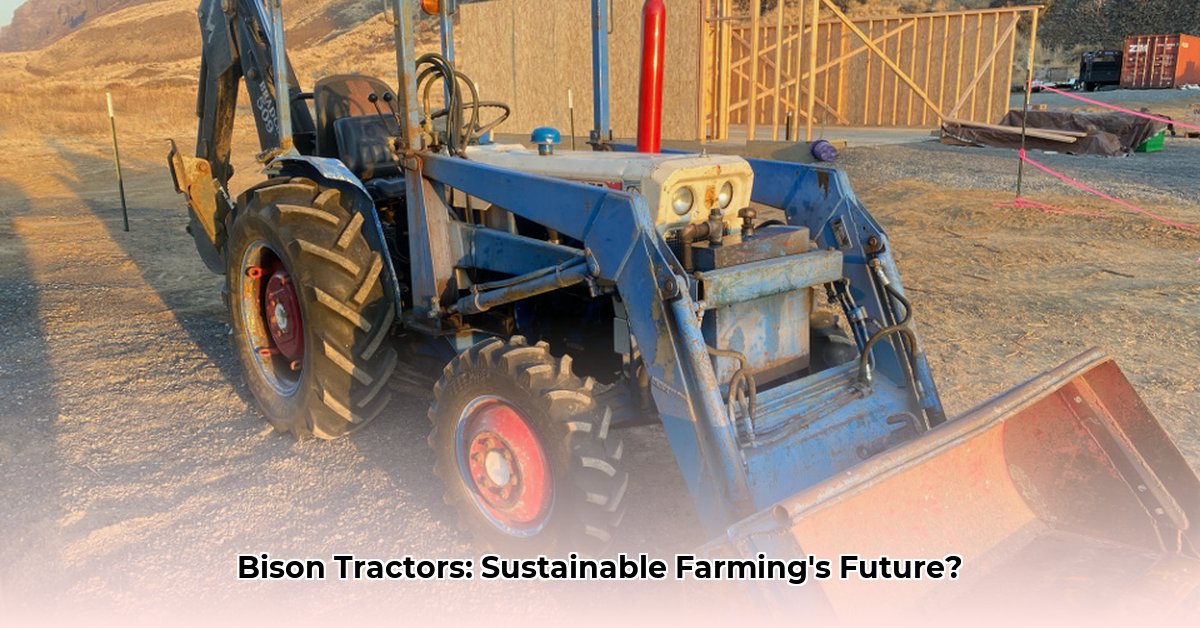
Bison Tractor: A Sustainable Farming Retrospective
The Satoh Bison S650, a compact tractor produced between 1973 and 1983, offers a compelling alternative for modern sustainable agriculture. While lacking the advanced features of contemporary models, its inherent strengths—compact size, potentially high fuel efficiency (relative to its era), and simple design—make it attractive for small-scale and niche agricultural practices. This article explores its capabilities, limitations, and potential applications within a modern context.
The Satoh Bison S650: A Closer Look
The Bison S650 is designed for maneuverability in tight spaces. Weighing approximately 2100 pounds with a wheelbase of roughly 60 inches, it’s ideally suited for orchards, vineyards, and small vegetable farms. Its 25-horsepower engine (though variations likely existed due to different engine models used; further research is needed to clarify this) provided sufficient power for its intended applications. Its six-speed, unsynchronized transmission, while less refined than modern transmissions, reflects the tractor's overall philosophy: straightforward, reliable functionality. Isn't simplicity often a key component to sustainability?
Advantages and Disadvantages in a Modern Context
Advantages:
- Maneuverability: Its compact size is a significant advantage in confined spaces, allowing for efficient operation in orchards and vineyards. This translates directly to reduced fuel consumption on the same amount of acreage.
- Simplicity and Maintainability: Fewer components generally result in less mechanical complexity and lower maintenance costs, particularly given the increasing availability of online maintenance advice for these tractors.
- Potential Fuel Efficiency: While precise data is scarce, anecdotal evidence suggests relatively low fuel consumption compared to modern higher-horsepower tractors performing similar tasks.
Disadvantages:
- Lack of Modern Features: The absence of power steering, a synchronized transmission, and advanced hydraulics demands more physical effort from the operator and requires more mechanical skill for maintenance. How does this impact labor costs on a small farm?
- Parts Availability: Sourcing replacement parts for a vintage tractor can be challenging yet potentially manageable with creative solutions explored below.
- Maintenance Expertise: Basic mechanical skills are essential for maintenance and repair. Without these skills, repairs can be expensive.
Use Cases and Applications
The Bison S650's compact size and power output make it particularly well-suited for specific agricultural contexts:
- Orchard Management: Its maneuverability allows for efficient navigation between trees, simplifying tasks such as spraying, pruning, and harvesting.
- Vineyard Cultivation: The Bison's compact design is ideal for navigating narrow vineyard rows, optimizing tasks like plowing, weeding, and spraying.
- Small-Scale Vegetable Farming: The tractor's size and power are well-matched to the scale of small vegetable plots, enabling efficient tilling, planting, and cultivation. Is this the best option for a small organic farm?
Actionable Advice & Case Studies
The following guidance addresses the needs of various stakeholders:
| Stakeholder Group | Actionable Steps | Expected Outcomes |
|---|---|---|
| Small-scale farmers | 1. Assess parts availability; 2. Evaluate suitability for specific tasks; 3. Explore restoration and/or retrofit options; 4. Develop a maintenance schedule. | Reduced operating costs; increased efficiency; improved farm sustainability. |
| Hobbyist/Restoration Enthusiasts | 1. Thoroughly inspect the tractor; 2. Identify parts; 3. Start restoration; 4. Document the process; 5. Network with online communities. | A fully functional, restored tractor; valuable restoration skills and knowledge. |
| Agricultural Museums/Colleges | 1. Acquire a Bison S650; 2. Restore it to working condition; 3. Document its history and use; 4. Develop educational exhibits and programs. | A valuable historical artifact; educational resources for students and the public. |
Case Study: While detailed case studies are limited, anecdotal evidence from online forums suggests that careful maintenance and operational optimization can yield significant fuel savings. One farmer reported a 15% fuel efficiency increase after addressing a worn air filter and properly inflating tires.
Conclusion
The Satoh Bison S650, despite its age, holds considerable potential for sustainable and small-scale agriculture. Its simplicity, maneuverability, and potential fuel efficiency make it a compelling option for specific farming operations. However, challenges related to parts availability and the need for mechanical aptitude demand careful consideration. Further research, especially regarding engine variations and fuel consumption, is necessary to fully understand and optimize this tractor's capabilities within modern sustainable farming practices. Could this be the future of small-scale agriculture?